

Our Science · How we work
How we work: Scientist-Driven Development
- Veterinary diagnostic labs stop retyping submission forms.
- Materials and transportation testing labs stop retyping field sheets.
- Government research and contract testing labs keep requests and results together.
- Environmental and other testing labs replace a LIMS that no longer fits.
Our software runs in production for clients including UW Veterinary Care, Maine DOT, and NIEHS. Your first step is a thirty-minute conversation with an expert.
We deliver a laboratory system in four phases, Understand, Build, Adopt, and Sustain, and we run each one as an experiment. The Understand phase is an on-site analysis of your workflow at a fixed scope and a fixed price. Build ships one proven step at a time, with training and testing documentation alongside. Adopt is go-live with a support plan, and Sustain keeps improving what went live.
A way of building software scientists recognize.
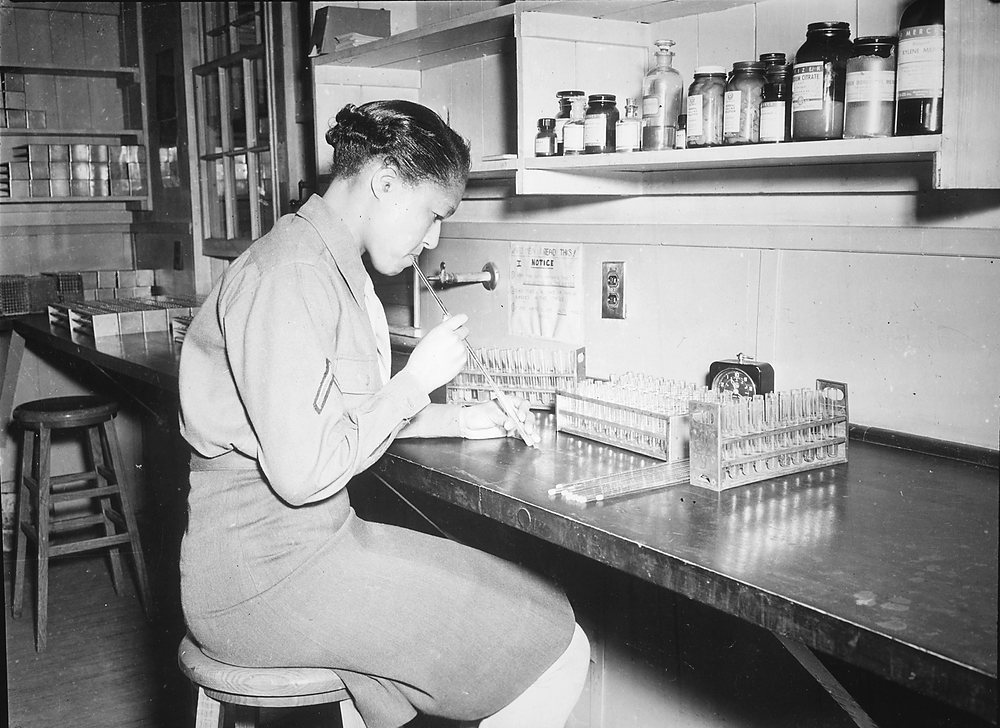
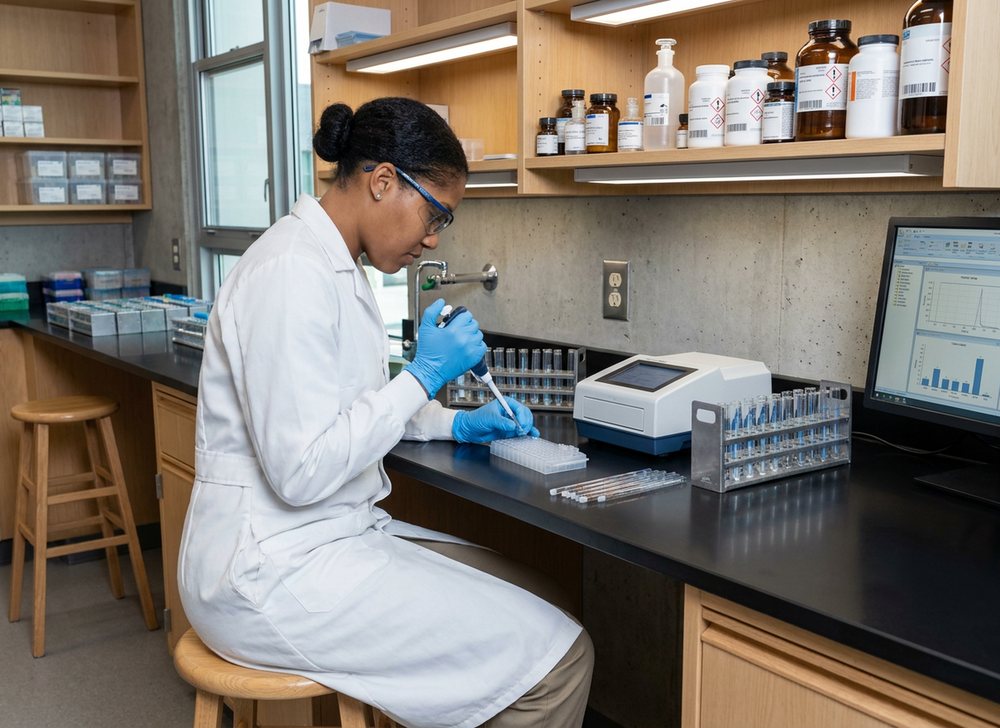
THEN · 1944 · Wikimedia Commons · NOW · digitally rendered
THEN · 1944 · Wikimedia Commons, from the U.S. National Archives (NARA 531360), U.S. Army Signal Corps · public domain NOW · digitally rendered from the archive photograph above (Gemini 3 Pro Image, 2026-09-15): the room geometry, the camera and the people's positions are the photograph; everything else is generated. Not a photograph.01The method
The scientific method, run as a delivery loop
We deliver in phases, starting with a fixed-scope on-site Understand phase, then one proven step at a time, so you see a working result before you commit further.
We call the method Scientist-Driven Development. It runs the scientific method as an agile delivery loop. A story is a hypothesis, a build is the experiment, adoption is the analysis, and Sustain is the conclusion, which starts the next loop.
In your laboratory, that means three steps, in order.
- We write a hypothesis about how the work runs with the people who run it.
- We measure where the work happens, at the bench, in user testing, and after go-live.
- You see a working result before anything more is committed.
We run the company the same way. We form a hypothesis, test it small, and keep what proved.
02The four phases
What each phase produces
We run each phase as an experiment.
01
Understand
the hypothesis
- how your laboratory actually works
- a needs summary
- user stories
- plans you can hold us to
fixed scope · fixed price
02
Build
the experiment
- one proven step at a time
- training and testing documentation
a few months to more than a year
STORIES CONFIRMED
ACCEPTED IN UAT
03
Adopt
the analysis
- a support plan
- system documentation
- a maintenance plan
your staff know how to run the system
THE NEXT STEP BEGINS
IN PRODUCTION · ONGOING
04
Sustain
the conclusion
- an annual operation analysis
- feedback and adaptation
a scientist who knows your lab
Inside Sustain →SCIENTIST-DRIVEN DEVELOPMENT
the loop continues, step after step
01
Understand
the hypothesis
- how your laboratory actually works
- a needs summary
- user stories
- plans you can hold us to
fixed scope · fixed price
STORIES CONFIRMED
02
Build
the experiment
- one proven step at a time
- training and testing documentation
a few months to more than a year
ACCEPTED IN UAT
03
Adopt
the analysis
- a support plan
- system documentation
- a maintenance plan
your staff know how to run the system
IN PRODUCTION · ONGOING
04
Sustain
the conclusion
- an annual operation analysis
- feedback and adaptation
a scientist who knows your lab
Inside Sustain →
THE NEXT STEP BEGINS
SCIENTIST-DRIVEN DEVELOPMENT
the loop continues, step after step
Understand
the hypothesisWe analyze on site how your laboratory actually works. Then we deliver a needs summary, user stories, and plans you can hold us to. Understand has a fixed scope and a fixed price.
Build
the experimentWe build one proven step at a time against a delivery plan, and we deliver training and testing documentation alongside the software. Build can run from a few months to more than a year, depending on the pieces you choose.
Adopt
the analysisYour laboratory goes live with a support plan, system documentation, and a maintenance plan, and your staff know how to run the system.
Sustain
the conclusionSustain starts at contract execution and continues year by year. It brings an annual operation analysis, feedback, and adaptation, with a scientist who knows your lab keeping the system improving after go-live.
03How estimates are made
Story points, in the open
Every story carries an estimate you can see. A story point measures how big a story is compared with others the team has already estimated, taking in its effort, its complexity, and what is still unknown. We plan against a probabilistic baseline instead of a best case, and we show you the confidence level we planned to.
When a piece of work runs long, you see it in the same numbers we do. The figures behind the baseline are shown in the conversation, from your own plan.
04Contracting
Two ways to contract a project
Understand is scoped and priced on its own. You decide whether to build with the needs summary, the stories, and the plans in hand.
Table Professional Services, the same price records as Pricing → Project services.
Effective 1 October 2026. Time and materials is billed per hour, per statement of work. Every other line is one-time.
| Service | Terms | Price |
|---|---|---|
| Laboratory Informatics Scientist, time and materialsper hour | per statement of work, approved in writing | $260 |
| Prepaid block, 50 hoursper prepaid block of 50 Laboratory Informatics Scientist hours | drawn down hourly against approved Professional Services; expires twelve months after purchase unless the Order states otherwise; no rollover beyond expiry | $12,350 |
| End User Trainingper training engagement | two days for up to ten users | $10,400 |
| Administrator Trainingper training engagement | five days for up to five administrators, builders or designers | $16,640 |
Larger prepaid blocks, on the same terms as the 50-hour block:
- per prepaid block of 100 Laboratory Informatics Scientist hours: $23,400
- per prepaid block of 250 Laboratory Informatics Scientist hours: $55,250
- per prepaid block of 500 Laboratory Informatics Scientist hours: $104,000
License plus hosting is our software-as-a-service price. Time and materials and fixed scope are two ways to contract the same project work. Sustain is bought separately, as its own part of the price.
05After go-live
Sustain keeps improving what went live
We understand, build, and adopt one proven step at a time, and then Sustain keeps improving what went live.
Inside Sustain, three questions decide who does what.
- Is it broken? We fix it. That is Coverage, included with your license.
- Is it working, but could be better? We improve it. That is your Service Level.
- Is it something new, with a date and a definition? That is a project. We scope, price, and commit it separately, and the loop above runs again.
06Before the first meeting
Map a laboratory workflow
Print the questions we ask in the first hour of the Understand phase, answer what you can, and bring them to the first conversation. We start from your answers.