

Products & services · Software
DOTSci
The Maine Department of Transportation runs its materials-testing laboratory on DOTSci, and our software also runs for other clients, including UW Veterinary Care and NIEHS. Your first step is a thirty-minute conversation with an expert.
DOTSci is a laboratory information management system (LIMS) for materials-testing laboratories, designed to support laboratories working to AASHTO and ASTM test methods. It follows each specimen from the field through testing and review to the report, on one record, even where the field crew has no signal. The first step is a conversation with one of our laboratory informatics experts.
Every specimen stays on one record, from the field to the report.
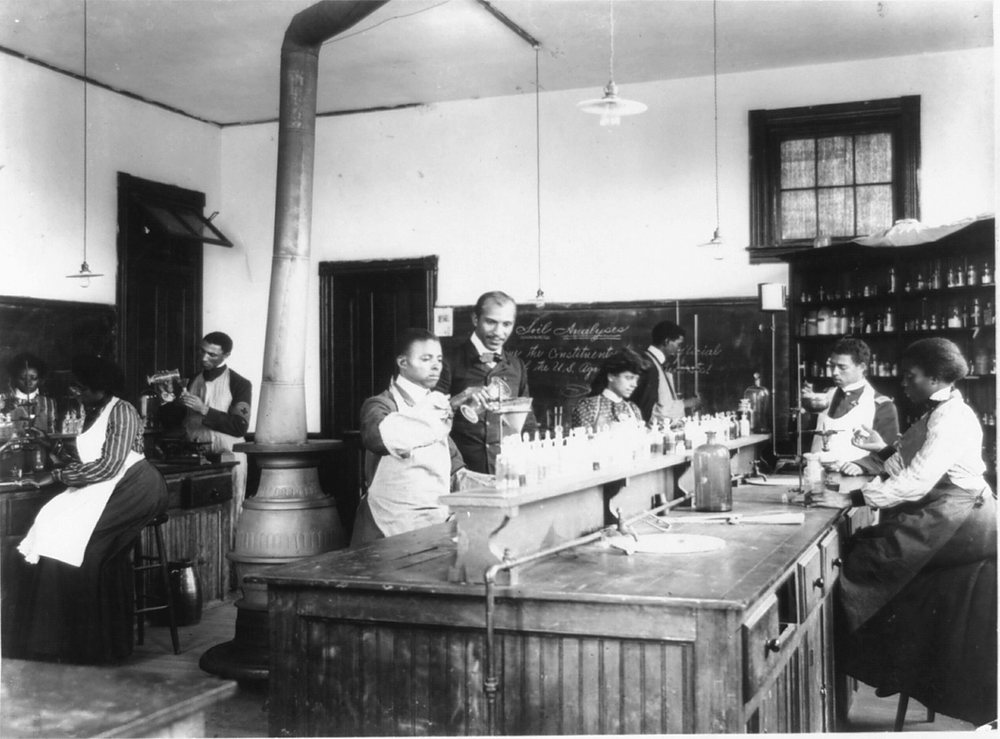
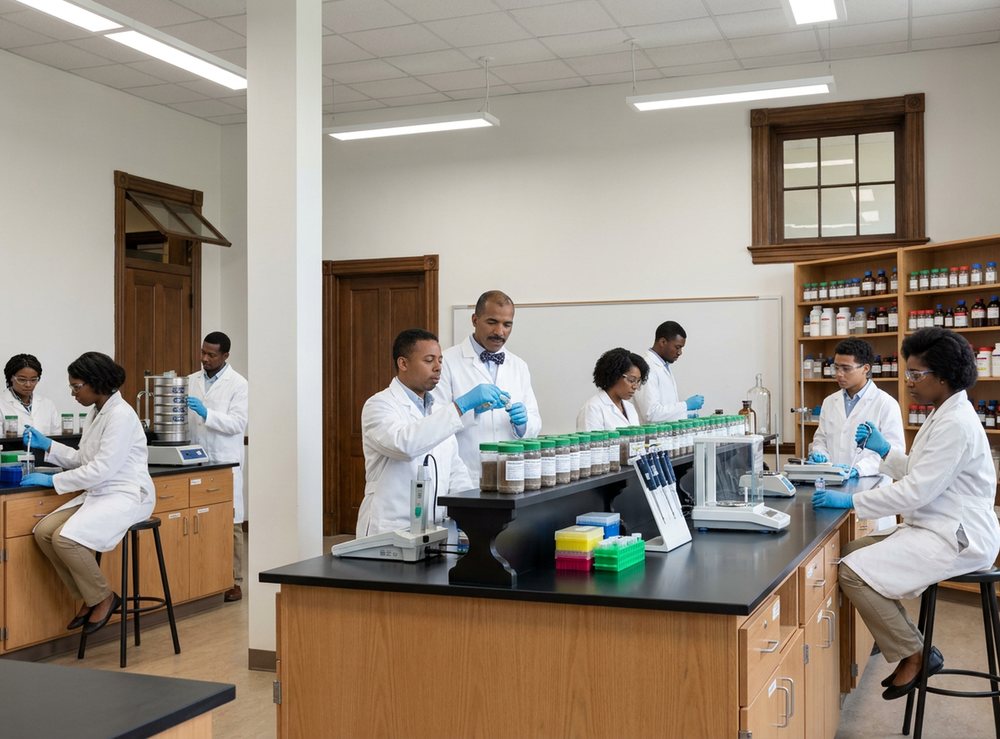
THEN · 1902 · Library of Congress · NOW · digitally rendered
THEN · 1902 · Frances Benjamin Johnston · Library of Congress, Prints & Photographs Division · no known restrictions on reproduction · loc.gov/item/2001703725 NOW · digitally rendered from the archive photograph above (Gemini 3 Pro Image, 2026-09-26): the room geometry, the camera and the people's positions are the photograph; everything else is generated. Not a photograph.Opens your print dialog. Choose Save as PDF.
01How we help
Sample to report, on one record
A specimen is logged and barcoded where it is taken, offline if there is no signal, and synchronized when there is. At the bench, results are entered against the method the technician is running and evaluated against the specification as configured. A validate step gates release, and the equipment register keeps each instrument’s calibration schedule and sends the reminders. The report goes to the district, the project, or the contractor, and the pay item is recorded against the same record.
Specimens and samples
Specimens are logged, split, and tracked from the field to the bench to disposal.
Test methods
Designed to support laboratories working to AASHTO and ASTM test methods, with each result entered against its method and validated before release.
Equipment and calibration
The equipment register keeps calibration schedules, reminders, metrology, and preventive maintenance in one place.
Facilities and pay items
Each result is recorded against the laboratory and district the work runs through, and against its pay item.
Offline field capture
Field crews record samples where there is no signal, and the record synchronizes when there is.
Barcode traceability
Specimens are labeled at capture and traced by barcode from the field through the bench.
Data exchange
Results go to the state transportation information system without re-keying, as delivered for the Maine Department of Transportation.
Reporting
Structural reports are built in Power BI, reviewed, and released to the people who asked.
External portal
Submitting agencies and contractors enter their own samples through the portal, which the Maine Department of Transportation is previewing.
The product documentation builds every DOTSci record from four concepts.
- Project or request context
- Sample and test assignment
- Method and specification evaluation
- Result and report lifecycle states
Results are entered and validated, and completion rules gate the report, so an unvalidated result cannot be delivered. The method you configure drives result entry and the specification checks. Data like specifications and report settings are rows that your laboratory maintains as configurable data. Every state change is designed to be auditable and reproducible. The full documentation set comes with the product.
Leadership
If you run the laboratory
We developed DOTSci alongside the Maine Department of Transportation’s materials-testing division, and it runs on LabSci. Implementation is scoped after the Understand phase, our fixed-scope, on-site study of how your laboratory works, and you see each piece working before you commit to the next. After go-live, Sustain is a Service Level sized to your laboratory and priced per year. Migration is its own project, priced after we have seen the source system.
Bench
If you work the bench
The truck comes back with cylinders, cores, and bags of aggregate, and each specimen already has a barcode and a record, because the crew logged it in the field and the capture synchronized on the way in. You scan it, open the method you are running, and enter the result against that method, whether it is a sieve stack, a break, or a moisture test. The specification check runs as you go. Nothing is re-typed from a field sheet at the end of the day, and nothing waits on a signal.
QA
If you review and sign
A result is entered, validated, and status-evaluated before a report can be delivered, and completion criteria gate every reporting action. The equipment register carries each instrument’s calibration schedule and reminders, so “when was it last verified?” is answered from the record. Audit history, a Dataverse feature, records who changed a record and when. DOTSci is designed to support laboratories working to AASHTO and ASTM test methods, and your laboratory demonstrates conformance on its own methods.
IT
If you administer the tenant
DOTSci is delivered as two managed Dataverse solutions, one for the LabSci platform base and one for the DOTSci product layer. It installs in your tenant or is hosted by SynapticSci, with three environments (development, user acceptance testing, and production) and a client solution of your own above both.
- Licensing is Power Apps per user or per app for the model-driven apps, plus Dataverse capacity.
- Sign-in is Entra ID, with MFA where your tenant enforces it.
- The installation path is documented, so your IT group can own it, or we run the deployment pipeline as a service.
- Release notes come with every deployment.
Releases move from development to user acceptance testing to production as managed solutions, with smoke checks after each deployment. Configuration rows move with a table-by-table review, and production changes only through a release. We have delivered the exchange with a state transportation information system for the Maine Department of Transportation. Trust, validation, and IT →
02The problem
Why materials laboratories replace what they have
A state DOT materials-testing laboratory exchanges results with the transportation information system its engineers already use, and re-keys them to get them there. The test was run once and the number is typed twice, and the second copy is the one the pay item is paid from.
A laboratory’s calibration records live in a binder, and the binder is only as current as the last person who touched it. When an assessor asks which compression machine produced a result and when that machine was last verified, the answer is a walk to the shelf.
A field crew samples where there is no signal, and the paperwork catches up days later, or does not. By the time the sample reaches the bench, the field sheet is the only record of where it came from and who took it. Meanwhile, the agency’s IT group wants all of it on the Microsoft tenant it runs today.
03Method
Understand first, then one proven step at a time
We start with a fixed-scope on-site Understand phase, then build one proven step at a time, so your laboratory sees a working result before committing further. The four phases are Understand, Build, Adopt, and Sustain, and each runs as an experiment in which we hypothesize, test, and keep what proved. How we work describes each phase and how estimates are made.
Understand documents your laboratory’s methods, districts, and reporting obligations as they are, before anything is configured. Build delivers one piece at a time, such as one material, one method family, or one district’s reporting, each accepted by your own people. Adopt takes it live, and after go-live comes Sustain, where a named Laboratory Informatics Scientist improves your system one release at a time.
04Platform
Built on LabSci and Microsoft Dataverse
DOTSci is the materials-testing product on LabSci, a configurable laboratory platform built natively on Microsoft Dataverse and the Power Platform.
DOTSci installs as a product layer over LabSci. Your laboratory’s own configuration lives in a client solution above both, so product releases do not overwrite your work. Audit history, role security, and controlled records are administered through existing Dataverse features.
05Evidence
Where DOTSci runs today
Claim The Maine Department of Transportation runs its materials-testing laboratory on DOTSci, from sample to report.
Mechanism Samples, methods, specifications, calibration, and reporting share one Dataverse record, and results go to the state’s transportation information system without re-keying.
Artifact The laboratory’s own screens, shown in a conversation with its permission.
Result Maine Department of Transportation · DOTSci · in production since 2020, delivered by the team that founded SynapticSci in 2021 · exchange with the state’s transportation information system delivered.
Implementation plan is very clear and tuned to our requirements, agile and collaborative
State of Maine, RFP 201902032, Award Justification Statement, 2019
06Who this is for
Laboratories that test what the road is built from, and report to the people who pay for it
DOTSci fits three kinds of materials laboratory.
- State DOT materials divisions
- County and municipal materials laboratories
- Private geotechnical and construction-materials laboratories
Each receives soils, aggregates, asphalt, concrete, and steel from the field and from suppliers, tests them against a method, and checks the result against a specification before reporting to whoever is waiting on the number.
On our practice and problem pages
DOTSci appears on these practice and problem pages, next to the other approaches each page weighs.
Practice pages
Problem pages
Not for Contract administration and construction management. DOTSci exchanges results with the system you use for those. What DOTSci is not →
07Boundaries
What DOTSci is not
- The laboratory’s engineer certifies each method result, and DOTSci records it.
- Offline field capture records the sample where it is taken. It does not replace your laboratory’s sampling procedure or the person who follows it.
- The product core is the same for every client. Your own sequences, mappings, and connectors live in your configuration, and product releases do not redefine it.
08Pricing
Licenses and hosting, then Sustain, then the project
Table 1 LabSci license and hosting prices by item, the same as on Pricing. DOTSci runs on LabSci. Each is its own annual price.
Per year · minimum commitment twelve months · effective 1 October 2026. License and hosting are separate prices, and no combined figure is stated. Hosting: hosted by SynapticSci; none when self-hosted in your own tenant; requires the matching LabSci licence.
| Item | License | Hosting |
|---|---|---|
| Lab Userper named Lab User | $2,346 | $305 |
| Designer/Adminper named Designer/Admin | $4,691 | $611 |
| Portal, authenticated usersper pack of 100 authenticated portal users | $3,892 | $3,053 |
| Portal, anonymous visitorsper pack of 500 anonymous portal visitors | $1,348 | $1,145 |
The external portal for submitting agencies and contractors is bought as portal packs, in the same part as user licenses. Implementation is scoped after the Understand phase. Sustain gives you a named Laboratory Informatics Scientist who improves the system release by release. It is a Service Level of Included Hours, sized to your laboratory and priced per year on a twelve-month minimum (Pricing).
Migration is its own project, and you choose how much history moves.
- No migration
- Active data plus a year of history
- Everything
We price migration after we have seen the source system. Talk with an expert to work through implementation and migration for your laboratory.