

Laboratory Operations
The software does not fit how the laboratory works.
It comes up in every kind of lab we work with, from veterinary diagnostic to materials testing labs.
Our software runs in production for clients including UW Veterinary Care, Maine DOT, and NIEHS. Your first step is a thirty-minute conversation with an expert.
Many laboratories run software that records the work in a shape they do not follow. People work around it, and the workaround becomes the real process, kept outside the record. We can help you improve, integrate, extend, or replace what you have, starting with the part of the work that needs it most.
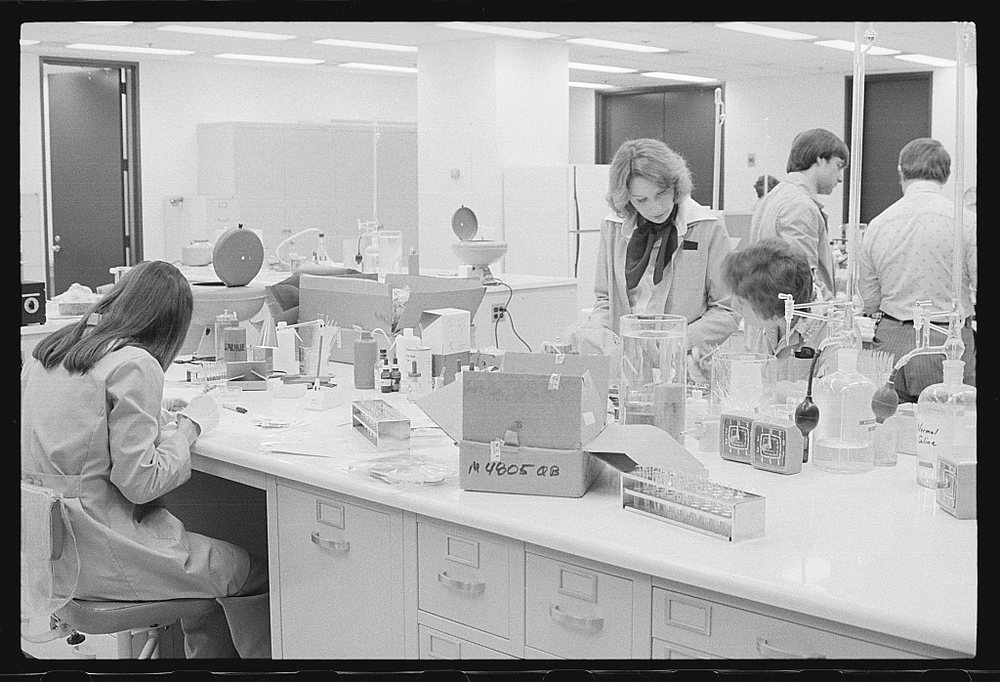
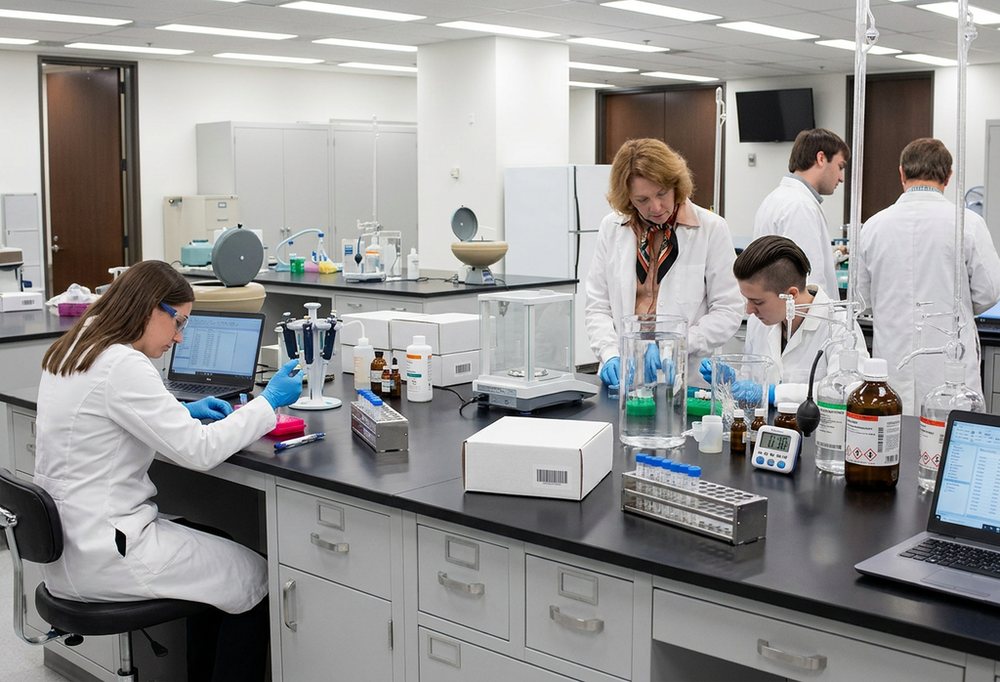
THEN · 1976 · Library of Congress · NOW · digitally rendered
THEN · 1976 · Library of Congress · Library of Congress, Prints & Photographs Division, FSA/OWI Black-and-White Negatives · no known restrictions NOW · digitally rendered from the archive photograph above (Gemini 3 Pro Image, 2026-09-26): the room geometry, the camera and the people's positions are the photograph; everything else is generated. Not a photograph.01The difficulty
People work around the software
A sample type the system cannot hold is tracked in a spreadsheet. A review step the system does not know about happens by email. Research workflows change from project to project, and not all of them fit a standard package.
02Getting started
Start with one workflow your software does not fit
Start with the part of the workflow that needs attention. The work comes in three sizes.
- An assessment compares each path against how your laboratory actually works. We do it with you in the Understand phase, our on-site analysis of your workflow at a fixed scope and price.
- A focused intervention closes one gap with a configuration change, an integration, an extension, or FormSense.
- A broader change replaces the system, with the ongoing services you choose.
We give a price once the work is sized to your records, interfaces, and users. The first step is a conversation with an expert about one workflow your software does not fit.
03Where it occurs
Wherever the software models the work differently from your laboratory
Where the gap sits
- Samples, tests, and methods.
- Instruments, equipment, and locations.
- Quality workflows and reporting obligations.
- Compliance, and the exceptions of a working day.
The laboratories that meet it first
- Veterinary Diagnostics, where the LIMS does not fit how a diagnostic laboratory works.
- Government Research Laboratories, where the software does not fit how research projects run.
- Laboratory Modernization, where the software no longer keeps pace with the laboratory.
Other problems are in the Laboratory Operations catalog.
04Approaches
Improve, integrate, extend, or replace
- Improve when the gap is in the process or the configuration. A change to either may close it.
- Integrate when the software is right for its part of the work and the gap lies between it and another system.
- Extend when one part of the work has no home in the current system.
- Replace when the software cannot be shaped to the work, and then one step at a time.
05Tools and services
What fits, and when
- delivered example
- work delivered for an existing client and described on the Evidence page.
- available approach
- a product, module or service SynapticSci offers today.
- scope to assess
- something to establish with your laboratory in the Understand phase, before any tool is chosen.
- available approach LabSci Fits when the laboratory needs a record system shaped to its work. Delivered for the National Institute of Environmental Health Sciences. Explore LabSci
- delivered example VetSci and DOTSci Fits when the laboratory is a veterinary hospital or diagnostic laboratory, or a materials-testing laboratory. Delivered for University of Wisconsin Veterinary Care and Maine Department of Transportation. Explore VetSci · Explore DOTSci
- available approach FormSense Fits when paper intake has no home in the current system. Explore FormSense
- scope to assess Workflow assessment Fits when it is not yet clear which path makes sense. The Understand phase
- available approach Phased delivery Fits when a change is warranted but its risk has to stay small. How we work
- available approach Migration Fits when records have to move to a new system. Migration and data