
Problem catalog

Laboratory Operations

Our software runs in production for clients including UW Veterinary Care, Maine DOT, and NIEHS. Your first step is a thirty-minute conversation with an expert.

Start from the problem in front of you, without choosing an industry first. Twelve laboratory problems are grouped by what goes wrong, each with the question a laboratory asks and how we help today. Where we have done the work before, for clients such as University of Wisconsin Veterinary Care, Maine Department of Transportation, or the National Institute of Environmental Health Sciences, the entry links it.

Solve the problems slowing your laboratory.

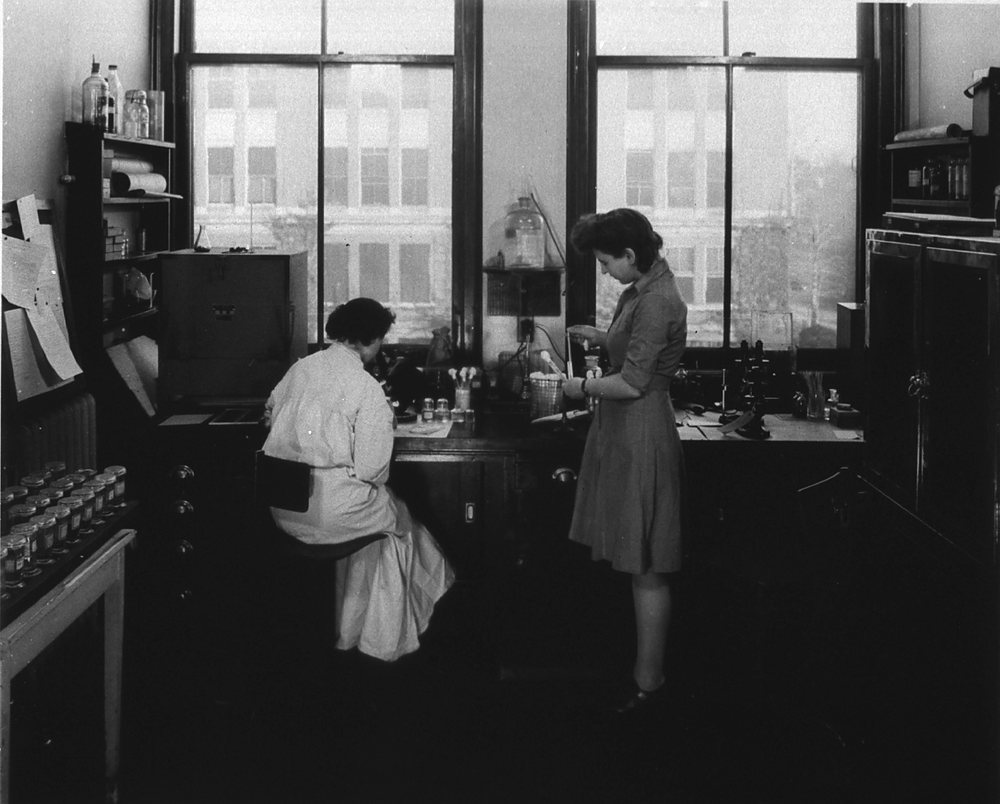
THEN · INFORMATION DOES NOT FLOW Two women in a laboratory beneath tall windows: one sits at a microscope on a dark bench, the other stands beside her holding a flask; shelves of jars and a wall of papers frame the scene.
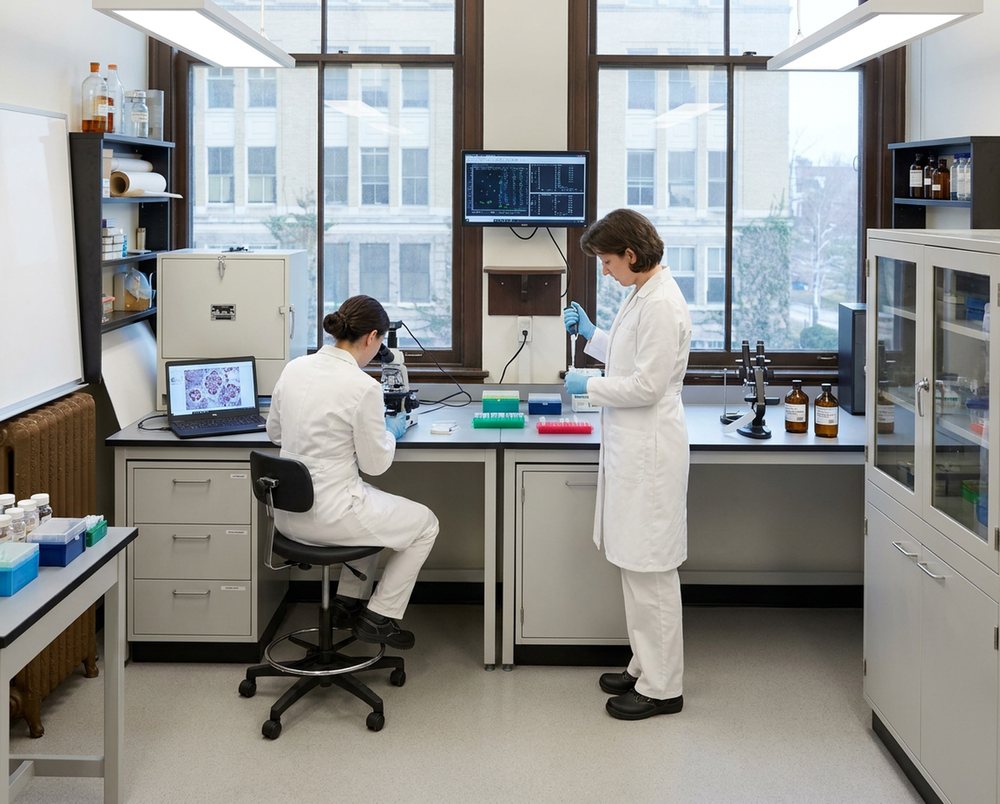
Digitally rendered from the archive photograph: Same windows and bench; a digital microscope with a monitor, a rack of barcoded tubes and a laptop replace the 1944 flask, jars and paper wall. NOW · ONE CONNECTED RECORDNOW · DIGITALLY RENDERED
Fig. 1 A parasitology diagnostic laboratory, 1944.
THEN · 1944 · National Library of Medicine · NOW · digitally renderedTHEN · 1944 · National Library of Medicine · public domain NOW · digitally rendered from the archive photograph above (Gemini 3 Pro Image, 2026-09-26): the room geometry, the camera and the people's positions are the photograph; everything else is generated. Not a photograph.

01The catalog

Twelve problems in three groups

Pick the problem that sounds most like your laboratory. When the cause is not yet clear, we start with the Understand phase, our on-site analysis of your workflow at a fixed scope and price.

delivered example
work delivered for an existing client and described on the Evidence page.
available approach
a product, module or service SynapticSci offers today.
scope to assess
something to establish with your laboratory in the Understand phase, before any tool is chosen.

Information that does not flow

Work that is hard to coordinate

Systems that are hard to trust or sustain

02Problem group

Information that does not flow

The same information is typed in twice.

The question How can information move into the record without unnecessary re-entry?

Start where the information first arrives, then remove every place it gets typed again.

  • available approach FormSense reads paper forms and worksheets, and a person reviews every field before it reaches your LIMS.
  • delivered example Instrument interfaces that carry analyzer results straight into the record, built for University of Wisconsin Veterinary Care.

Systems do not share the information people need.

The question How can records move between existing systems with clear ownership?

Agree which system owns each record, then connect the systems you keep.

Equipment and calibration records are disconnected from the work.

The question How can equipment status and records be linked to testing?

Record which equipment each test used, and keep its calibration history alongside it.

  • delivered example Equipment and calibration records kept with the tests they qualify, built for the Maine Department of Transportation.
  • available approach DOTSci adds calibration reminders and barcode traceability for materials testing.
  • available approach LabSci has equipment, calibration, and preventive maintenance modules.

Reports still have to be assembled by hand.

The question How do reviewed results become the right report for the right recipient?

Trace each report back to the reviewed results it draws on, then decide what can be generated automatically.

  • available approach VetSci includes reports to submitters.
  • available approach LabSci includes a reporting module, and Power BI reporting is available now.

03Problem group

Work that is hard to coordinate

It is hard to see what work is waiting or where it is stuck.

The question How can the team see status, queues, and handoffs?

Agree what counts as waiting and what counts as stuck, then make the queue visible.

  • scope to assess Our Understand phase maps your queues and handoffs before anything is built.
  • available approach LabSci includes My Work and Sample management modules.

Results take too long to reach the people waiting for them.

The question Where is time accumulating, and what change would help?

Agree where the clock starts and stops, then find where the time goes.

  • scope to assess Our Understand phase pinpoints the delay with your team before anything changes.
  • available approach Power BI reporting is available now.

Too much work depends on repeated manual follow-up.

The question Which handoffs, reminders, and routine tasks can be improved?

List every follow-up, and ask whether each one is needed at all.

  • scope to assess Our Understand phase identifies the follow-ups worth changing before anything is built.
  • available approach DOTSci sends calibration reminders for materials-testing laboratories.

Research or service work is scattered across requests, samples, and results.

The question How can a project’s or request’s context stay attached to the work?

Decide what context travels with each request, and keep it on one record.

04Problem group

Systems that are hard to trust or sustain

It’s hard to reconstruct what happened to a record.

The question How do you keep who changed a record, what changed, and why, connected to the record itself?

Decide what has to be reconstructable, and for whom, then keep that history on the record.

  • available approach Audit trails, role-based access, and controlled records come with the platform. Trust, validation and IT
  • available approach DOTSci follows each specimen with barcode traceability.
  • available approach FormSense keeps what was read and what a reviewer changed on every field at intake.

The software does not fit how the laboratory works.

The question Should you improve, integrate, extend, or replace your software?

Start with how your laboratory works, then compare each option against it.

  • available approach LabSci is configured to your workflow in the Understand phase.
  • available approach We deliver in phases, so you see a working result before committing further. How we work

Laboratory data does not add up to a reliable view of performance.

The question Which definitions and records can support decisions without another spreadsheet?

Agree what each measure counts, and which records it is counted from.

  • scope to assess Our Understand phase settles the definitions and their source records before any report is built.
  • available approach LabSci includes a reporting module, and Power BI reporting is available now.

Keeping the system useful depends on workarounds and the few people who know them.

The question How can the system be maintained, improved, and handed over responsibly?

Document what the system depends on, then spread that knowledge and make each change safer.

  • available approach Sustain keeps the system running and improving after go-live, with Included Hours each month and Coverage for when something breaks.
  • available approach Releases move through separate development, user acceptance testing, and production environments, with notes for every release.
Talk with an expert