Products & services · Bench Tools

FormSense, for any laboratory where paper still arrives

FormSense comes from the team whose software runs in production for clients including UW Veterinary Care, Maine DOT, and NIEHS. Your first step is a thirty-minute conversation with an expert.

FormSense reads the paper and handwritten forms your laboratory already receives and, once a person approves each field, sends them into your LIMS as records. Your team spends less time typing forms in and more time at the bench doing science.

Less re-keying. More science.

THEN · PAPER WORKSHEETS MISS THE RECORD Barbara McClintock, in round spectacles and a buttoned smock, leans over a bench holding a slender pipette above two petri dishes and a small bottle; a binocular microscope stands at her left beneath a bright window. Archive photograph, 1947.
Digitally rendered from the archive photograph: Same bench, same window. A scientist in gloves and safety glasses holds a dropper over two petri dishes, beside a microscope with a camera and a screen, a rack of capped tubes and a closed notebook. NOW · PAGES EXTRACTED AND REVIEWED INTO RECORDSNOW · DIGITALLY RENDERED
Fig. 1 Barbara McClintock in her laboratory, 1947. A laboratory’s record has always started by hand.
THEN · 1947 · Smithsonian Institution Archives · NOW · digitally rendered THEN · 1947 · Smithsonian Institution Archives (Science Service) via Wikimedia Commons · public domain · Commons file: Barbara McClintock (1902-1992) shown in her laboratory in 1947 NOW · digitally rendered from the archive photograph above (Gemini 3 Pro Image, 2026-09-26): the room geometry, the camera and the people's positions are the photograph; everything else is generated. Not a photograph.

Opens your print dialog. Choose Save as PDF.

01Who this is for

Laboratories where paper still arrives at the desk

Not every laboratory will ever be fully digital. Submission forms, worksheets, and bench logs still arrive on paper, and someone has to type them in again. FormSense reads those pages for you and takes the re-typing off your team.

FormSense is a Bench Tool. It works with the LIMS you already run, so trying it is not a platform decision.

Not for Laboratories whose intake is already electronic from end to end. What it does not do →

02The problem

Where the record goes missing

My worksheets don’t make it into the record.

The accessioning desk, any Tuesday of the year

Intake is where the record first drifts away from the sample. A worksheet typed in from memory at four o’clock is a record nobody can audit.

  • The day’s worksheets are re-keyed into the LIMS at the end of the shift, by the person you can least spare.
  • A bench keeps a paper log because the instrument is nowhere near a keyboard, and the log is right until someone copies it.
  • A reviewer signs results whose intake step left no trail.

03How we help

Three steps from paper to a reviewed record

A page of a small lined pocket notebook written in ink: numbered sample entries for canned peas, beans, tomatoes and blackberries, each with the packer's name and town, and the price paid and the date in the margin.

from submission sheets to bench logs

  1. Submit

    Scan or photograph the page.

  2. Extract

    Printed and handwritten fields alike, every field a confidence score.

  3. Review

    A reviewer sees the page and the fields side by side, and approves.

Nothing reaches the LIMS unreviewed.

1890–1905, Wikimedia Commons, public domain

FormSense Review Workbench - scan, row grid and source evidence side by side before anything commits. Identifiers replaced; data synthetic.

The Review Workbench

For every field, the workbench shows the raw value read from the sheet, the final value, a confidence score, how the value was derived, and any manual override. Fields with low confidence are flagged for a person to check.

The Review Workbench, a handwritten worksheet beside its reviewed record, field by field On the left, a paper accession worksheet with four handwritten fields. Owner, Example Farm. Species, Bovine, serum. Test requested, BVD PCR. Collected, an unclear date. A scan line passes down the page, and a line carries each field into a record on the right, headed Review before anything commits, accession A-26-0412. For every field the record shows the final value, the raw value as read and how it was derived, a confidence figure and an override control. Owner, Example Farm, direct read, 98 percent, editable. Species, Bovine, serum, direct read, 96 percent, editable. Test, BVD-PCR panel, matched to test catalog, 94 percent, editable. Collected, held for review, override required, 41 percent. The foot reads 3 fields ready, 1 held. Nothing is written to the record until a reviewer says so. All values are made up, and the confidence figures only illustrate the mechanism. ACCESSION WORKSHEET PAGE 1 OF 1 OWNER Example Farm SPECIES Bovine, serum TEST REQ. BVD PCR COLLECTED 8/3?/26 REVIEW BEFORE ANYTHING COMMITS ACC A-26-0412 FIELD FINAL VALUE · RAW · DERIVATION CONF. OVERRIDE OWNER Example Farm raw: EXAMPLE FARM · direct read 98% editable SPECIES Bovine, serum raw: BOVINE - SERUM · direct read 96% editable TEST BVD-PCR panel raw: BVD PCR · matched to test catalog 94% editable COLLECTED HELD FOR REVIEW raw: 8/3?/26 · override required 41% required 3 fields ready · 1 held. Nothing is written to the record until a reviewer says so. ACCESSION WORKSHEET PAGE 1 OF 1 OWNER Example Farm SPECIES Bovine, serum TEST REQ. BVD PCR COLLECTED 8/3?/26 CAPTURED · REVIEWED REVIEW BEFORE ANYTHING COMMITS ACC A-26-0412 OWNER 98% Example Farm raw: EXAMPLE FARM · direct read editable SPECIES 96% Bovine, serum raw: BOVINE - SERUM · direct read editable TEST 94% BVD-PCR panel raw: BVD PCR · matched to test catalog editable COLLECTED 41% HELD FOR REVIEW raw: 8/3?/26 · override required required 3 fields ready · 1 held. Nothing is written to the record until a reviewer says so. The Review Workbench, a handwritten worksheet beside its reviewed record, field by field On the left, a paper accession worksheet with four handwritten fields. Owner, Example Farm. Species, Bovine, serum. Test requested, BVD PCR. Collected, an unclear date. A scan line passes down the page, and a line carries each field into a record on the right, headed Review before anything commits, accession A-26-0412. For every field the record shows the final value, the raw value as read and how it was derived, a confidence figure and an override control. Owner, Example Farm, direct read, 98 percent, editable. Species, Bovine, serum, direct read, 96 percent, editable. Test, BVD-PCR panel, matched to test catalog, 94 percent, editable. Collected, held for review, override required, 41 percent. The foot reads 3 fields ready, 1 held. Nothing is written to the record until a reviewer says so. All values are made up, and the confidence figures only illustrate the mechanism. ACCESSION WORKSHEET PAGE 1 OF 1 OWNER Example Farm SPECIES Bovine, serum TEST REQ. BVD PCR COLLECTED 8/3?/26 REVIEW BEFORE ANYTHINGCOMMITS ACC A-26-0412 FIELD FINAL VALUE · RAW ·DERIVATION CONF. OVERRIDE OWNER Example Farm raw: EXAMPLE FARM ·direct read 98% editable SPECIES Bovine, serum raw: BOVINE - SERUM ·direct read 96% editable TEST BVD-PCR panel raw: BVD PCR · matchedto test catalog 94% editable COLLECTED HELD FOR REVIEW raw: 8/3?/26 ·override required 41% required 3 fields ready · 1 held. Nothing is written to the record until areviewer says so.
Fig. 2 One reviewed field in the Review Workbench, with made-up data and illustrative confidence figures.
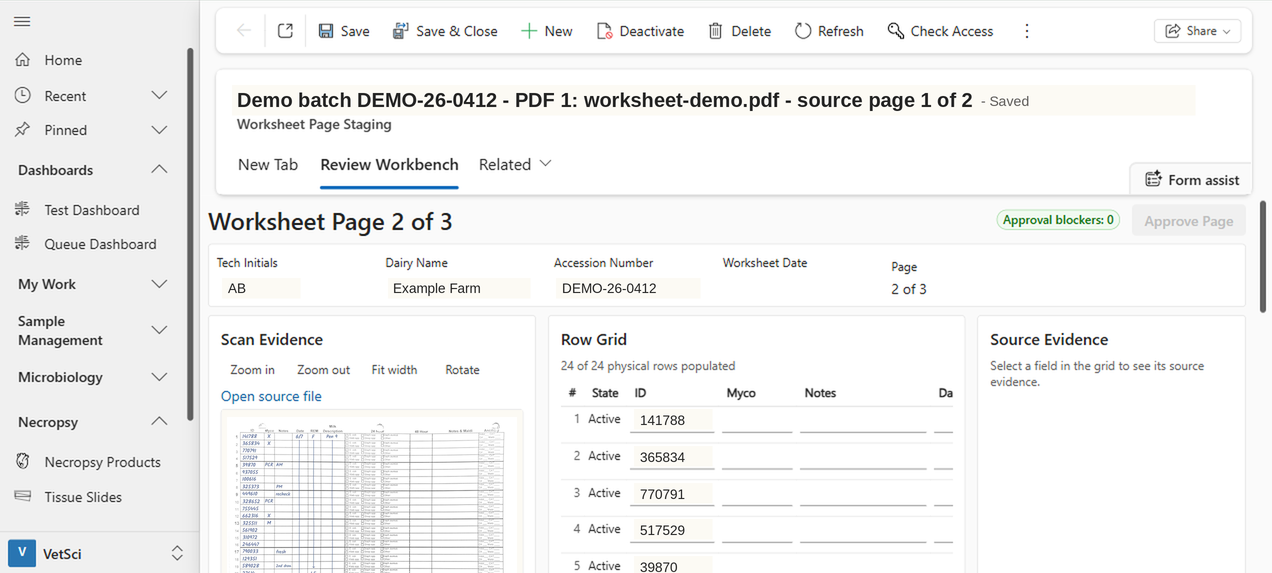
The FormSense Review Workbench inside a model-driven app: a worksheet page record with its header fields, an Approve Page control showing no approval blockers, and three panes side by side. They show the scanned page, a grid with one row per worksheet line, and a source-evidence pane. Identifiers replaced; data synthetic.
Fig. 3 The Review Workbench as built. The scan, the row grid and the source of each value sit side by side before anything is saved. SCREENSHOT · FormSense demonstration environment · masked 2026-09-05 · every visible value is synthetic

One sheet, seven records

One approved log sheet became the request items your LIMS expects. Each one traces back to the page and the reviewer.

One sheet, seven records A single approved worksheet, handwritten Example Farm, BVD PCR and stamped approved, sits at the left. From its edge seven lines fan out to the right, each ending in a node named for the record it becomes. The records are Sample, Test, Owner, Patient, Veterinarian, Person to be billed and Report recipients. Pulses leave the sheet along each line, except when reduced motion is preferred. All values are made up. ONE WORKSHEET Example Farm BVD PCR APPROVED Sample Test Owner Patient Veterinarian Person to be billed Report recipients One sheet, seven records A single approved worksheet, handwritten Example Farm, BVD PCR and stamped approved, sits at the left. From its edge seven lines fan out to the right, each ending in a node named for the record it becomes. The records are Sample, Test, Owner, Patient, Veterinarian, Person to be billed and Report recipients. Pulses leave the sheet along each line, except when reduced motion is preferred. All values are made up. ONE WORKSHEET Example Farm BVD PCR APPROVED Sample Test Owner Patient Veterinarian Person to be billed Report recipients
Fig. 4 One approved sheet becomes seven linked records, from the sample to the report recipients.

It works with the LIMS you run

FormSense does not need our LIMS. It delivers approved records through an adapter configured for the system you already run, and we scope that adapter with you. On LabSci, reviewed records become ordered request items on the same platform. Export to PDF or spreadsheet is also available.

Leadership

If you run the laboratory

Trying FormSense is a small decision. It changes intake and leaves your LIMS strategy alone. You pay by the page. Nothing moves to production until you decide.

Bench

If you work the bench

The worksheet stays. You scan or photograph the page and drop it in the queue, and the Review Workbench shows the page and its fields side by side. What you approve is what the record says. Nobody retypes the day’s sheets at four o’clock, and the person who used to do it reviews the exceptions instead.

QA

If you review and sign

Every field keeps its raw value, final value, confidence score, derivation, and any override, and a named reviewer approves it. The transcription step you could not audit becomes a record you can. Approved pages are staged before they are saved, so the record shows what reached the LIMS and who allowed it.

IT

If you administer the tenant

FormSense runs in your own Microsoft tenant or hosted by SynapticSci. Microsoft’s document-reading service in Azure reads the pages, and reviewed records land in Dataverse staging tables before they become ordered request items. Reviewers sign in with Entra ID. Use is metered by FormSense Credit, one credit per page when it reaches review, and named users are unlimited. Platform certifications are Microsoft’s, and we cite them as Microsoft’s.

Want to see it on your own forms first? Test a form → Ready to start? Talk with an expert →

04Platform

Where your pages live

Reviewed pages become Dataverse records on the platform beneath LabSci. If your LIMS is another vendor’s, the adapter carries the approved records across.

FormSense runs in your own Microsoft tenant, where your laboratory’s data already lives, or SynapticSci hosts it for you.

Hosted

Hosted by SynapticSci

Hosting is the fastest way to put your own forms through the Review Workbench.

Your tenant

Your own Microsoft tenant

FormSense is deployed in your laboratory’s own Microsoft environment, and in the standard deployment the data does not leave your tenant. Where your data lives →

05Evidence

What we can show

We have run FormSense on real laboratory log sheets. The screenshot and the fan shown here come from that work, with every identifier replaced. We show measured read rates, review times, and exception counts when we meet. Ask to see them →

FormSense on real laboratory log sheets, on the Evidence page

The Date column of a worksheet across twenty-four rows, cropped as a strip: one written value and a single continuous ink line drawn down the column. The REM column of the same worksheet: a written letter in the first row and one continuous ink line carrying it down the column. Rows one to ten of the REM column enlarged: the written letter and the start of the carry-down line, with the ink close to the column rule.
Fig. 5 The carry-down convention FormSense had to learn. One written date and one letter are each carried down the column by a single ink line that hugs the rule, the kind of shorthand a person reads instantly. Crops of the benchmark page, with no identifiers in frame and nothing altered. CROPS · benchmark page · no identifiers · nothing altered

06What it does not do

What FormSense does not do

  • It does not approve a page by itself. A person approves every page.
  • It does not promise an accuracy figure.
  • It reads only the forms it has been set up for.
  • It does not contact the practices named on the forms your laboratory receives. Your submitters stay yours.
  • It does not certify a regulated process. It gives your validation the audit trail it needs.
  • It is a Bench Tool that feeds the LIMS you run, and it does not replace that LIMS.

07Pricing

Metered by the page

Use is metered by FormSense Credits, one for each page that reaches review, with tiers sized to your monthly volume. Ask for the figures →

Retries, corrections, and delivery use nothing more, and named users are unlimited. Guided onboarding, dedicated deployment, and premium support are priced separately. The full price list is on the pricing page.

The charge point: one credit when a page reaches review, and nothing after it A path carries the three steps of FormSense from left to right, 01 Submit, 02 Extract and 03 Review. The node at Review is the only filled node on the path, and it is ringed once, because one credit is charged when a page reaches review. Past that node the path runs into three open nodes for retries, corrections and delivery, under a band reading consume nothing more. A short branch leaves Submit for an open node labeled named users are unlimited. The whole mechanism is metered by the page. A pulse travels the path, except when reduced motion is preferred. METERED BY THE PAGE 01 Submit 02 Extract 03 Review One credit is charged when a page reaches review retries corrections delivery named users are unlimited CONSUME NOTHING MORE Submit Extract Review One credit is charged when a page reaches review CONSUME NOTHING MORE named users are unlimited The charge point: one credit when a page reaches review, and nothing after it A path carries the three steps of FormSense from left to right, 01 Submit, 02 Extract and 03 Review. The node at Review is the only filled node on the path, and it is ringed once, because one credit is charged when a page reaches review. Past that node the path runs into three open nodes for retries, corrections and delivery, under a band reading consume nothing more. A short branch leaves Submit for an open node labeled named users are unlimited. The whole mechanism is metered by the page. A pulse travels the path, except when reduced motion is preferred. METERED BY THE PAGE 01 Submit 02 Extract 03 Review One credit is charged when apage reaches review retries corrections delivery named users are unlimited CONSUME NOTHING MORE
Fig. 6 One FormSense Credit is charged when a page reaches review, and nothing after that point uses another.

08Where it fits

Where FormSense fits

Talk with an expert