

Laboratory Operations
The same information is typed in twice.
It comes up in every kind of lab we work with, from veterinary diagnostic to materials testing labs.
We built the analyzer interfaces at UW Veterinary Care and the transportation-system exchange at Maine DOT, so those results reach the record without being typed in again. Your first step is a thirty-minute conversation with an expert.
Information that already exists gets typed in again, from a paper form, an analyzer, or another system. Every copy adds work and a chance to get the record wrong. We have built instrument interfaces for University of Wisconsin Veterinary Care, and FormSense reads paper forms so a person reviews every field before it reaches your LIMS. Start with one form your laboratory types in twice, and talk with us about it.
01The difficulty
The test is run once, but its record is typed more than once
A result is written on a worksheet, typed into the LIMS, and keyed again into a report or another system. Each pass takes time away from the bench and gives the record another chance to differ from the original.
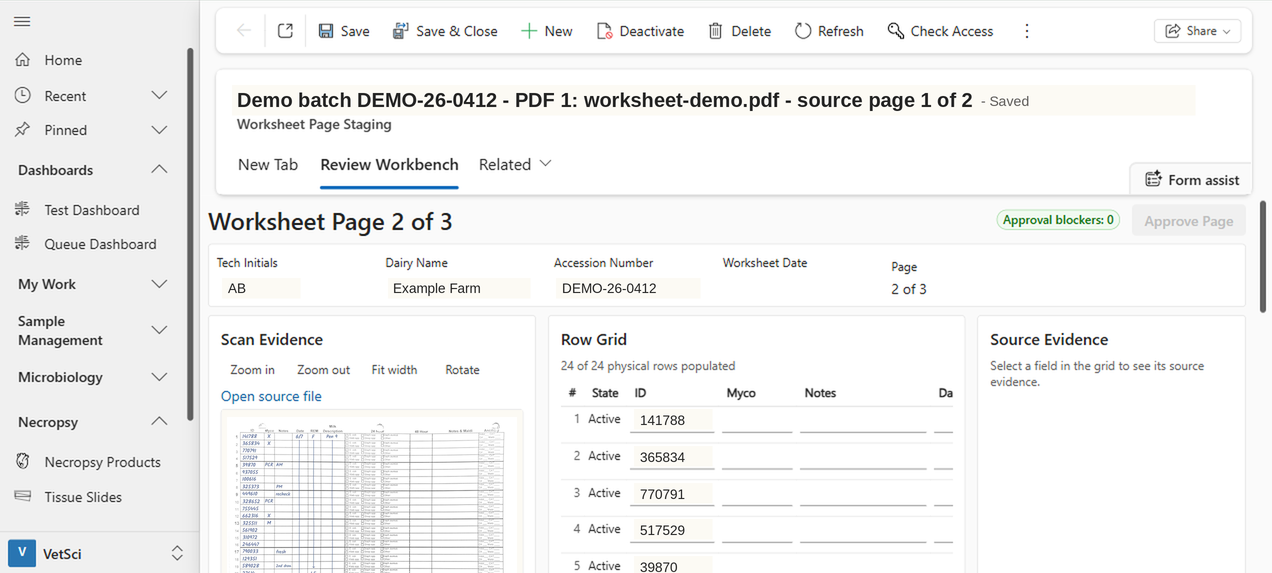
When the information arrives on paper, FormSense reads the form, and a person reviews every field before anything reaches your LIMS. It is available now. See FormSense on real laboratory log sheets.
When the information comes from an analyzer, an instrument interface carries the result straight into the record. We have built instrument interfaces for the analyzers at University of Wisconsin Veterinary Care.
02Where it occurs
Wherever information crosses without a connection

1944

NOW · DIGITALLY RENDERED
Re-entry happens in four places.
At intake
Arrives on paper, typed into the record.
At the instrument
Read off a screen or a printout, entered again.
In the field
What was written is entered again at the laboratory.
Between systems
Each system keeps its own copy.
A soils laboratory at Iowa State College, 1944: the sample, the reading and the notebook on one bench
1944, Wikimedia Commons, public domain
Digitally rendered; not a photograph.
The laboratories that meet it first
- Veterinary Diagnostics, where submission forms are typed in again at accessioning.
- Transportation & Materials Testing, where field records are typed in again when specimens reach the laboratory.
- Laboratory Modernization, for any laboratory working on efficiency.
Other problems are in the Laboratory Operations catalog.
03Why it matters
A record typed from memory cannot be audited
A worksheet typed in from memory at the end of the day cannot be checked against what was first written. Once information leaves the sample, every later step works from a copy. Capturing it where it first arrives keeps it attached to the sample it describes.
Before changing anything, map where the information first arrives, every place it is typed again, and who does the typing. Keep the review that matters, because removing the typing should not remove the check. Then judge the change on your own records by what is still typed twice, how complete the captured information is, and how much review remains.
04Getting started
Start with one form that is typed more than once
Start with the part of the workflow that needs attention. The work comes in three sizes.
- An assessment finds where information is typed again and which review has to stay. That is the Understand phase, our on-site analysis of your workflow at a fixed scope and price.
- A focused intervention changes one point of re-entry, with a process change, an interface, or FormSense on forms you already receive.
- A broader change adds software, implementation, data migration, and the ongoing services you choose.
We give a price once the work is sized to your records, interfaces, and users. The first step is a conversation with an expert about one form your laboratory types in twice.